
Built for the Long Haul: Resilient Habits for Firefighters and First Responders
As firefighters, EMTs, paramedics, and dispatchers, we dedicate our lives to keeping our communities safe and healthy. But in that constant commitment, it is incredibly easy to overlook our own well-being. My work with both the Safety Stand Down and the First Responder Center of Excellence (FRCE)—combined with training thousands of first responders and digging deep into current tactical research—has shown me a clear reality: career longevity doesn’t require complex, high-priced biohacking fads.
It rests on simple, foundational truths.
To build an environment where crews can optimize their personal health while meeting operational demands, we have to look directly at the hidden engines driving our stress response: physical training, hormonal balance, sleep hygiene, and culture.
1. Strength Training & Hybrid Programming: Build Career Durability
Strength training is the ultimate form of PPE for a tactical athlete. As we age, maintaining muscle mass is non-negotiable to avoid sarcopenia (muscle wasting), which leaves individuals vulnerable to a host of health risks, including cardiovascular disease, the number one killer in the fire service. Regular resistance training combats muscle loss, keeps joints resilient, and prevents the chronic back, knee, and shoulder issues that force good people into early retirement.

A balanced, hybrid fitness blueprint is highly effective: 2–3 days of functional strength training combined with 2–3 days of cardiovascular work. Consolidating physical stress is key. If a routine includes a higher-intensity session, pair the next window with low-impact cardio and mobility work to preserve cardiovascular conditioning while keeping total joint impact low.
On higher-intensity strength days, focus on challenging working sets that get near, but not completely to, muscular failure on compound movements to build true durability without overtaxing the system.

Looking for a complete firefighter and first responder workout program? Click the photo above to be directed to the FRF Hero X Program.
2. Strategic Sleep Hygiene: Protect the Glymphatic System
Quality rest is a critical pillar of frontline performance. Landmark screening data from Brigham and Women’s Hospital found that sleep disorders affect nearly 40% of first responders, dramatically driving up the risk of cardiac events, diabetes, and depression.
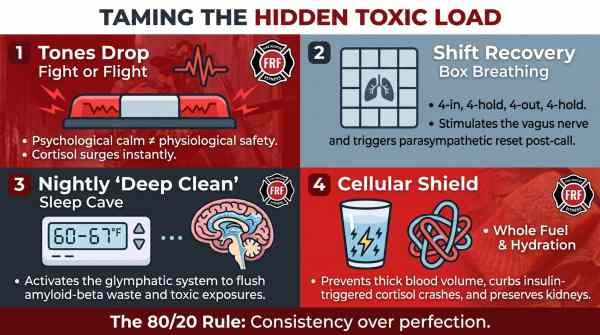
While getting 7 to 9 consecutive hours on a shift or during a busy call night isn't always possible, tactical health research shows that high sleep quality can significantly mitigate the damage from low sleep quantity. Deep sleep is when the brain activates its glymphatic system—essentially a daily "deep cleaning" that flushes out the metabolic waste and amyloid-beta plaques that accumulate from toxic exposures and sleep loss. Side-sleeping physically enhances this glymphatic drainage.
Off-duty sleep hygiene should be a strict priority:
- Build a Sleep Cave: Keep your sleeping quarters quiet, blacked out, and cool—ideally between 60–67°F, which is biologically required for optimal deep and REM sleep.
- Establish a Digital Curfew: Turn off smartphones, TVs, and mobile data computers at least 30-60 minutes before bed. Blue light tricks the brain into thinking it’s daytime, crashing melatonin and spiking cortisol when the body should be winding down.
- The 80/20 Strategy: Sleep shouldn't be a source of stress. Sticking to a strict sleep regimen 80% of the time leaves room for a 20% flexibility window for life, family, and social connections. One or two nights of fragmented rest is fine. The issue arises when poor sleep becomes the norm.
3. Smart Supplementation: Tactical Damage Control
While no pill can replace a solid lifestyle or a clean diet, targeted supplementation can act as excellent baseline damage control against the physical toll of emergency response.
- Magnesium Glycinate: A natural muscle relaxant that lowers stress-induced cortisol levels, improves sleep efficiency, and supports soft-tissue recovery.
- Omega-3 Fatty Acids (EPA/DHA): Vital for fighting the systemic inflammation caused by constant occupational stress, protecting the cardiovascular system, and supporting long-term brain health.
- Glycine & Creatine: Tactical research indicates that taking 3g of glycine and 5g of creatine before a night of known sleep disruption or a tough shift can significantly protect cognitive function and minimize muscle damage the next day.
4. Hormonal Awareness & Stress Modulation: Taming the Cortisol Spike
Emergency services present a dangerous paradox: psychological composure does not equal physiological safety. A seasoned first responder can walk into a chaotic scene looking completely calm and feeling entirely under control. Still, beneath that steady exterior, the subconscious biology tells a totally different story.
The second the tones drop, the nervous system hijacks the body—heart rate spikes, breathing quickens, and the system floods with the stress hormone cortisol. While these acute hormonal surges give you the sharp hyper-focus required to perform under pressure, chronic and unmitigated stress keeps that baseline cortisol dangerously high long after you roll back into quarters. Over the course of a career, this constant chemical bath dysregulates the endocrine system via the HPA (Hypothalamic-Pituitary-Adrenal) axis.
So, even if a veteran responder feels mentally unbothered, their hidden physiology pays the tax, ultimately leading to tanked testosterone, thyroid dysfunction, severe systemic anxiety, and the rapid accumulation of stubborn visceral belly fat.
To counter this, first responders must train their nervous systems to down-regulate after incidents and shifts. The second, a high-stress call clears, initiating tactical box breathing (inhale for 4 seconds, hold for 4, exhale for 4, hold for 4) instantly engages the vagus nerve, signaling the body to drop out of fight-or-flight and step down into a restorative, parasympathetic state. Adjusting daily routines to reduce non-operational stress—such as using blue-light-blocking glasses or dimming station lights after sundown—helps reduce the cumulative load on the brain.
5. Wholesome Performance Nutrition: Fuel the Tank
What we put into our bodies directly dictates how we react to stress. Transitioning to a whole-foods diet and removing heavily processed foods, refined sugars, and industrial seed oils eliminates a major source of baseline inflammation.
A nutrition plan rich in lean protein (lean meats, fish, eggs) and clean, complex carbohydrates (oatmeal, vegetables, brown rice) keeps blood sugar stable. Avoid high-sugar, refined-carb snacks on busy nights. They cause sharp blood sugar crashes that trigger a sudden release of cortisol, fracturing sleep and keeping the body amped up.
Finally, finishing your last meal 2 to 3 hours before bed gives your body a fasting window, allowing it to focus on deep tissue repair overnight rather than active digestion.

6. Mindful Hydration!
For first responders operating in heavy gear, regular hydration is a foundational habit because waiting until you feel thirsty on a scene means your body is already in a state of operational failure. Losing just 1% to 2% of body weight through sweat reduces blood volume and thickens it like sludge, forcing the heart to work dangerously hard to pump oxygen and drastically increasing cardiac strain during high-stress calls. This fluid deficit directly compromises safety by starving the brain of the water needed for rapid decision-making, while depriving the joints of synovial fluid cushioning and stalling the nightly glymphatic "deep clean" that flushes inflammatory metabolic waste from the brain. Cultivating a consistent, proactive hydration habit ensures that blood volume is fully expanded *before* the tones drop, protecting immediate cognitive focus and tactical physical performance when a crisis hits.
Over a multi-year career, consistent hydration acts as an internal shield against the chronic, systemic inflammation and tissue breakdown that damages long-term health. Thick, sludgy blood from chronic dehydration increases vascular friction against arterial walls, accelerating plaque buildup and escalating the risk of line-of-duty cardiac events. Regular water intake also helps keep fluid moving through the kidneys, safely flushing out toxic muscle breakdown products like myoglobin before they can pool and cause acute organ damage. By committing to a daily routine of consuming 16 to 20 ounces of water with electrolytes early in a shift and maintaining consistent hourly fluid intake, tactical athletes can successfully flush cellular toxins, preserve their joints, and halt the body's damaging, long-term stress response.
7. Creating Your Own Resilient Homefront
First responder work subjects the body to severe, unpredictable adrenaline spikes followed by periods of complete stagnation. This constant, daily whipping of the central nervous system rapidly accelerates physical exhaustion and disrupts the body's natural ability to regulate stress.
On duty, crews must be hypervigilant, aggressive, and situationally aware—a state of hyperarousal. But walking through the front door at home can cause the system to crash into hypoarousal, leaving individuals feeling detached, unmotivated, cynical, and completely zoned out from their families. Breaking this cycle requires a growth mindset: viewing mental and physical fitness as skills you can intentionally develop, rather than fixed traits. Because hypoarousal makes a person feel completely apathetic, it is best never to rely on "seeing what you feel like doing" on days off.
Have a plan. Schedule off-duty time with concrete slots for movement, family activities, and hobbies. Most importantly, intentionally broadening a social circle to include meaningful connections outside emergency services creates a crucial psychological buffer and reinforces a healthy perspective.
Listen to Dr. Zemlok talk about this subject on the Better Every Shift Podcast (click here)

Career longevity in emergency services does not come from high-priced biohacking fads; it is built on simple, consistent fundamentals. By taking command of your strength, recovery, hydration, and nervous system, you equip your body to absorb the unrelenting physical and biological stress of the job. Prioritizing your well-being isn't just about surviving the next 24-hour shift—it's about staying durable for your crew, present for your family, and healthy enough to enjoy the retirement you’ve earned.
Commit to these foundational habits, control what you can control, and keep striving to get better every shift.

Aaron Zamzow (ZAM)
Resources
Barger, L. K., Rajaratnam, S. M. W., Wang, W., O'Brien, C. S., Sullivan, J. P., Qadri, S., Lockley, S. W., & Czeisler, C. A. (2015). Common sleep disorders increase risk of motor vehicle crashes and adverse health outcomes in firefighters. Journal of Clinical Sleep Medicine, 11(3), 233–240. https://doi.org/10.5664/jcsm.4534
Sullivan, J. P., O’Brien, C. S., Barger, L. K., Rajaratnam, S. M. W., Czeisler, C. A., & Lockley, S. W. (2016). Randomized, prospective study of the impact of a sleep health program on firefighter injury and disability. Sleep, 40(1), zsw001. https://doi.org/10.1093/sleep/zsw001
Lee, H., Xie, L., Yu, M., Kang, H., Feng, T., Logan, J., Nedergaard, M., & Benveniste, H. (2015). The effect of body posture on brain glymphatic transport. The Journal of Neuroscience, 35(31), 11034–11044. https://doi.org/10.1523/JNEUROSCI.1625-15.2015
Gordji-Nejad, A., Matusch, A., Kleedörfer, S., Patel, H. J., Drzezga, A., Elmenhorst, D., Binkofski, F., & Bauer, A. (2024). Single dose creatine improves cognitive performance and induces changes in cerebral high energy phosphates during sleep deprivation. Scientific Reports, 14(1), 4937. https://doi.org/10.1038/s41598-024-54249-9
Yamadera, W., Inagawa, K., Chiba, S., Bannai, M., Takahashi, M., & Nakayama, K. (2007). Glycine ingestion improves subjective sleep quality in human volunteers, correlating with polysomnographic changes. Sleep and Biological Rhythms, 5(2), 126–131. https://doi.org/10.1111/j.1479-8425.2007.00262.x
Share this:

